

 By Geoff Fisher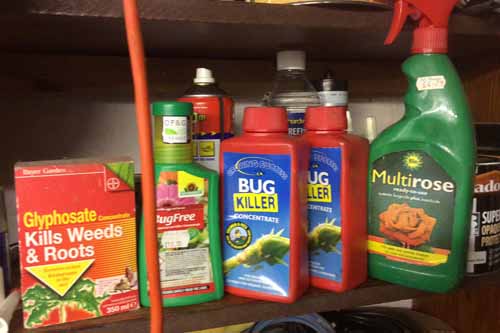
By Victoria Plum
Here is my “Shelf of Shame” (above). Spring cleaning recently, I found these horrible chemicals in the shed; I notice there are plenty for sale in my local garden centre and hardware shop.
Do not be deceived: I have used them but soon realised that the promised quick fix just does not happen. One year I carefully applied ghastly glyphosate to every bindweed plant as it grew, precisely focused like a funnel with the aid of a four-pint milk carton with the top and bottom cut out. So, was there any bindweed the following year? Of course there was.
Now I have learnt not to use any chemicals; I just pull up the stems when I see them and allow them to desiccate in the air. (The Romans used to steep pernicious weeds in water to kill them.)
I’m sure you know that just about any insecticide you apply will kill its target along with virtually anything else in the vicinity, including the natural predators.
I noticed a fascinating ring of tiny seedlings in my miniature garden (below). You can see how small they are by the scale of the moss and the sedum leaves. This little garden lives in an undrained saucer, outdoors, with no fertilisation or soil change, so growth is never lush, in fact all the plants therein have a hard time.
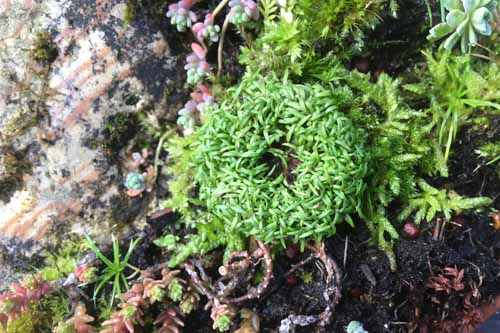
When I took it to the Reepham & District Gardening Club show in the summer (it won), I added some nigella seed pods for ornamentation – wonderfully weird alien-looking structures that they are, and I think these are the seeds that have grown. I look forward to seeing what happens next.
I have two dark-red, slim-flowered hardy fuchsias that I like very much, and they tolerate any amount of chopping back for my convenience. I was given a similar pink fuchsia that I never liked, but this year I have noticed how beautifully the pale flowers glow against a dark background just when there isn’t much colour in the garden.
The next gardening club meeting on Tuesday 17 February at 7.30 pm in the Town Hall, Church Street, Reepham, is about gardening in the shade. Plenty of shade in my garden from next door’s Bramley apple tree, which overhangs my garden, although the fallen fruit is a bonus.
People often plant big and rampant items at the edges of their gardens to try to make the most of their space without considering the impact on the neighbouring garden. Obviously, this applies to other people, not me, because I have a row of figs along the other edge of my garden.
I’m also looking forward to Simon Harrop’s gardening club talk on wildlife ponds in March, and of course Guy Barker, the Naked Gardener, to brighten up the AGM in April. All welcome to meetings.
Photos: Tina Sutton