
 By Geoff Fisher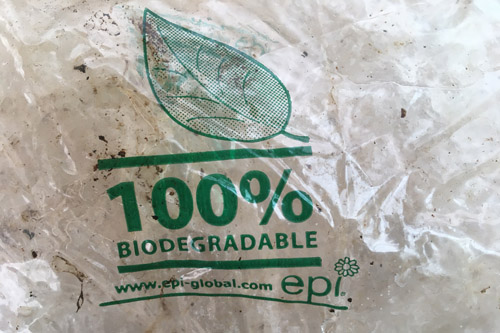
By Victoria Plum
I have been emptying my hot compost bin; it is Australian. It should be hot and fast at its work, but in fact it seems to be just damp like any heap, possibly not in an optimal position.
I am always interested to see what has happened to the random stuff I throw in. I have found it is true that stones do not compost down. I found knicker elastic; the cotton knickers (a test piece) have rotted.
Right at the bottom I found a sturdy plastic bag with very clear writing stating “100% Biodegradable”. So after about a year in my bin this bag had not decomposed and is in fact still in a very usable condition.
Remember that just about everything is biodegradable but sometimes you have to wait thousands of years.
The ice cream cartons have degraded, and also the paper and cardboard that I put in as the dry elements necessary for a mix for good composting with the green, wet stuff. Not so the Sellotape or plastic windows from envelopes.
The potato-starch wrappers in which some magazines come by post seem to degrade as they should. I usually rip these first, and I notice that the strands are still partially intact at the bottom of the bin, but obviously I just stick them back in the top to go through again, and they have become very fragile.
Jim Paine, our fascinating speaker at the February meeting of the Reepham & District Gardening Club, told us of the hypothesis that an ancient planet named Theia crashed into the ancient Earth, which caused the tilt of Earth’s axis, which in turn has given us the phenomenon of the seasons and incidentally the advent of the Moon.
Seasonality is crucial to the evolution of all life on Earth. Can you imagine what our world would be like with no seasonal changes?
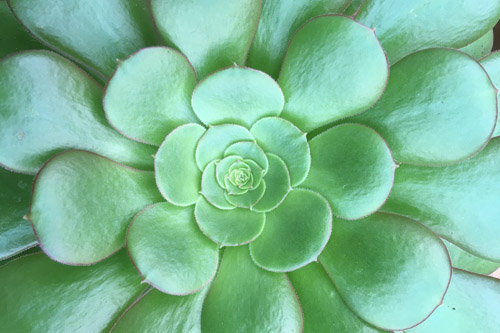
Jim explained phyllotaxy – the way in which plants organise their leaves to catch maximum light according to their environment. This is what I find so attractive about my succulents: the patterns their leaves form to maximise light absorption.
Have you ever noticed the spiral way that Brussels sprouts grow on their stalk? Did you know that this relates to the Fibonacci sequence that you can often see illustrated in a diagram on the set of TV’s QI and occurs constantly in nature in a variety of ways?
How lucky we are to have a proper nursery on our doorstep: Woodgate Nursery in Aylsham. I picked up a copy of the National Garden Scheme “Yellow Book” there, so that I don’t miss any garden openings, and I claimed my 10% discount, as you can too, for showing a gardening club membership card.
I am looking forward to next month’s gardening club speaker, Simon Harrop, telling us about ponds for wildlife. Join us in the Town Hall, Church Street, Reepham, at 7.30 pm on Tuesday 17 March. All welcome to these interesting evenings.
Above: 100% biodegradable (terms and conditions apply). Below: Aeonium showing phyllotaxy. Photos: Tina Sutton