

 By Geoff Fisher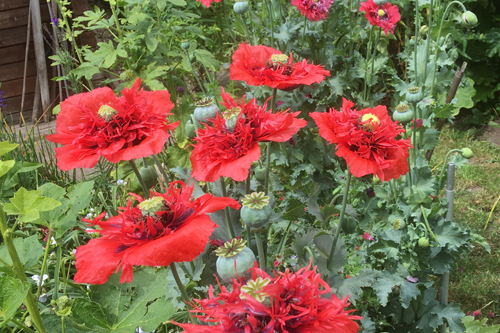
By Victoria Plum
Barely a spare seat in the town hall and many “oohs and aahs” from the appreciative Reepham & District Gardening Club audience for Andrew Sankey’s talk on making a cottage garden, with plenty of before-and-after photos.
Five years ago he moved to a new (oldish) garden in Norwich and on clearing all the overgrown shrubs and carefully evaluating possibilities had a clean slate to work on.
Two silver birches had conservation orders on them. There were problems (things don’t always go to plan where nature is involved), but it all seemed to come together effectively. He gave us a good plant list, too.
He made a new horizontal slat fence on one side, allowing you to see through it to a “borrowed view”, and also allowing climbers to climb up and through without having to put up wires. He favours a neutral fence colour (silver birch in this case) to show off foliage and flower colour to best advantage.
And if you have cause to get rid of nits, try drying the seeds from spindle, a useful, small garden tree, and put the powder in your hair; Mr Sankey assured us that it does work.
My new favourite book is No Nettles Required by plant ecologist Ken Thompson. The book is brimful of sensible, intelligent and researched information about nature in your garden.
He suggests that trees in our gardens are vital for attracting more insects, and you need as many elements of the food chain as you can to enrich variety and scope of wildlife.
Most interestingly (although I’m still less than halfway through the book), he mentions that although some insects require a specific plant, in the main all those tiny things that we need to encourage haven’t read the same plant lists, or books, as us, and are not that fussy about where they live or feed. The important thing is to have a variety of plant life, and they are likely to find somewhere to make themselves at home.
These plants don’t have to be “natives” but a variety of flower types, and the longest season you can organise, from Mahonia in the spring to ivy in the winter. And regarding “natives” it seems that not many are.
Hollyhock, that quintessentially English cottage garden flower, was apparently brought back from the Crusades for its medicinal qualities. I strove to grow it in my garden but have now got to the stage where I must be brutal and remove a number; it has made itself too much at home.
This year my opium poppies have been spectacular and with no effort from me. Apparently, our climate is not conducive to a useful crop, so I just use the little black savoury seeds to put on my bread. I make sure I throw the seed pods around when I clear up, an investment for next year. The colour mix and range of singles, doubles and in-between flower types varies each year.
All welcome at the next gardening club meeting so please bring your gardening friends to Reepham Town Hall, Church Street, on Tuesday 21 July at 7.30 pm to hear the wonderful Ian Bedford tell us about companion planting.
Stop press
In the news today, publicity about the dangers of spot-on flea and tick treatment for dogs and cats, which I mentioned in this column some years ago. It has been known since 2017 that fipronil and imidacloprid are both hugely dangerous for waterways, bees and insects and now an acknowledgement that they are oversold by vets as a preventative when they should only be used when necessary.
Above: Opium poppy. Photo: Tina Sutton